How to Wear Your Fit Model Bikini Properly
NPC Fit Model launched in 2025. The class is a balanced, athletic, naturally feminine physique — toned and shapely, closer to a fitness-magazine cover than the extreme leanness required in Bikini. The suit rules are not Bikini with the stones peeled off. The back-coverage rule changes how you put the suit on.
Sizing help: see the Fit Model size guide for how to measure and which bottom cuts pass check-in.
The most common mistake we see in our Clearwater, Florida workshop is the back of the bottoms worn too high. That both shortens coverage and wrecks the symmetry the judges are scoring.
SY Competition Suits manufactures Fit Model suits in Clearwater, Florida. Lucy McCudden has built competition wear here since 1996. Suits are built to NPC and IFBB Fit Model guidelines. That is not federation approval, and it is not a guarantee. The NPC, NPC Worldwide, and IFBB Professional League have not authorized or granted the license, authority, or exclusivity to any competition suit company or designer to be their official suit maker. Head-judge check-in is the test. Bring a second suit.
What Fit Model judges are scoring
Published judging criteria, in plain language:
- Condition — leanness and muscle tone, less extreme than Bikini.
- Symmetry and balance — upper and lower body in proportion.
- Presentation — clean front and back poses.
- Muscularity — a foundation of muscle, less developed than current NPC Bikini.
The suit has to frame that physique. Placement is part of the picture the table sees.
The 50% coverage rule, and why wearing it high fails you
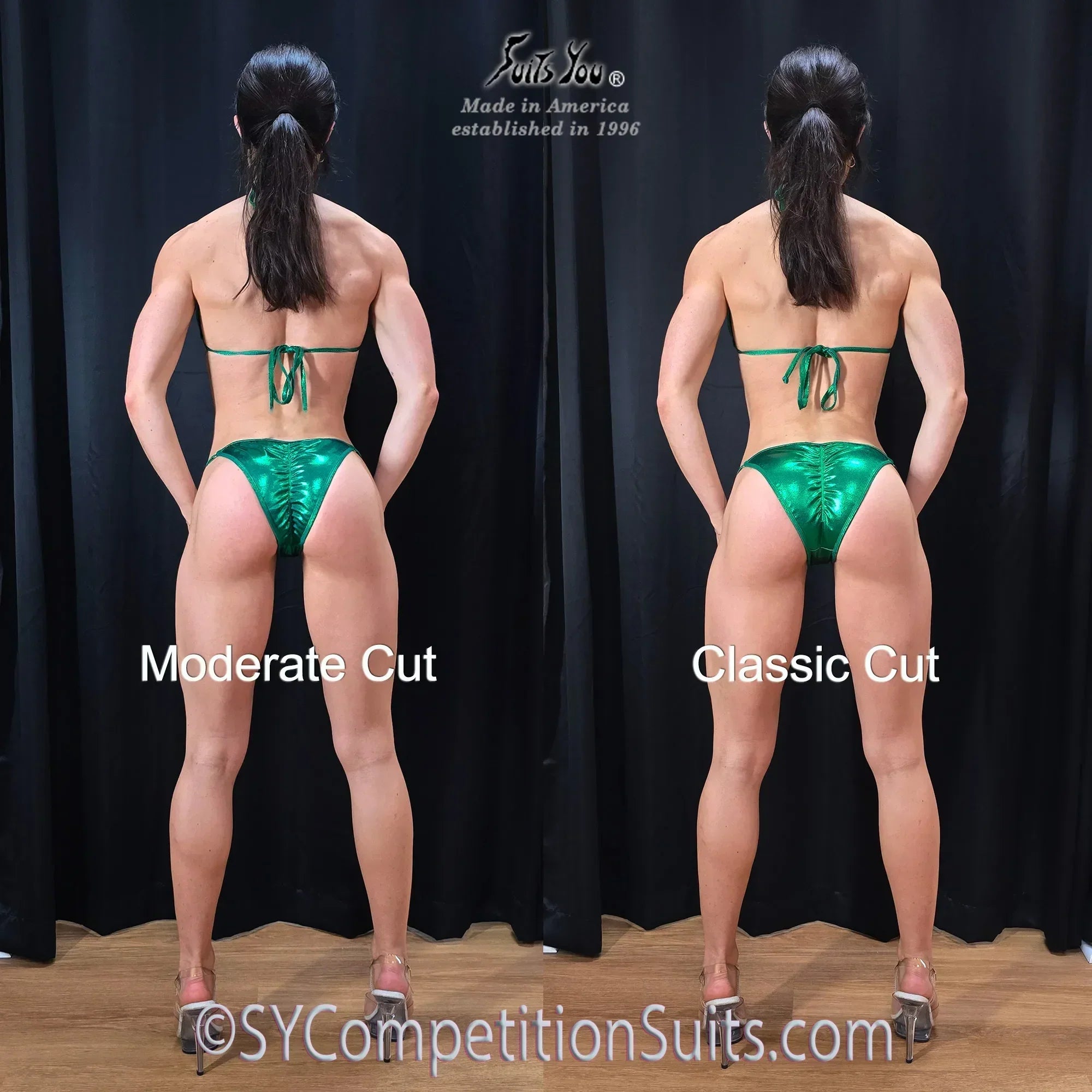
The bikini bottom must cover at least 50% of the glutes in the back. Thongs, micro cuts, pro cuts, and Brazilian cuts do not meet that standard and get flagged at check-in.
More fabric in the back means more fabric that can ride. Athletes pull the back up thinking it lifts the glute. It does the opposite.
- Coverage. When the suit rides, the lower glute shows. That is the half the rule is talking about.
- Long-glute effect. A line across the middle of the glute flattens it. Fit Model wants round and full.
- Front panel drop. Back goes up, front comes down. A low front lengthens the torso and unbalances the silhouette in the front pose.
Fit Model suit guidelines (confirm before the show)
| Rule | Requirement |
|---|---|
| Fabric | One solid color; Spandex or Metallic only |
| Embellishments | No crystals, stones, sequins, beads, or bling |
| Connectors | Not permitted |
| Front coverage | Moderate; slightly rounded or scooped — no sharp V |
| Back coverage | Minimum 50% glute coverage; scrunch back allowed if 50% holds |
| Side ties | Not permitted; slide adjusters, not strings |
| Suit style | Two-piece required |
| Footwear | High heels required |
SY Fit Model bottoms use slide adjusters rather than tie-sides so you can set the hip without a visible bow. That follows the no-tie guideline. It is not a pass from the federation. Confirm current rules on NPC News Online. Full list: NPC Fit Model division rules.
Step-by-step placement
1. Anchor the back
Put the bottom on and start with the back. Pull the back panel down until it sits near the glute crease — the natural fold at the bottom of the glute. The fabric should cover the lower half. Let it sit low. If the suit has a scrunch, run the seam evenly down the center so both glutes match.
2. Set the front
Once the back is anchored, lift the front so it sits on the hip bones. Moderate, slightly rounded — not a sharp V. If the front wants to drop, the back is still too high. Drop the back until the front stays up. That tension is what keeps the suit in the pose.
3. Check from all angles
Photograph front, side, and back in the pose, not at ease. Each glute should be at least half covered. Have a coach or teammate check the back. Center the front. Match the hip height on both sides.
4. Adhesive
More fabric in the back means more fabric that can shift. Apply competition-suit adhesive to the lower edges of the back panel, the sides of the front panel, and the hips. Press and hold. The lower back edge is where ride-up starts — and where a 50% fail starts. Adhesive keeps placement; it does not make the suit “approved.”
Fit Model vs. Bikini — you cannot swap the suit
| Aspect | Fit Model | Bikini |
|---|---|---|
| Embellishments | No crystals or bling | Crystals allowed |
| Connectors | Not permitted | Allowed |
| Front shape | Slightly rounded; no sharp V | V-shaped front |
| Back coverage | Minimum 50% | V-bottom, no thong |
| Side ties | Not permitted | Allowed |
| Fabric | Spandex or Metallic only | Wider fabric range |
A crystal Bikini suit will not pass Fit Model check-in.
Posing in the suit
Fit Model posing is a classic front pose (one leg in front, slight hip tilt) and a back pose. You hold still. The table has time to see how the suit sits. Practice in the actual Fit Model suit. Hold each pose at least 30 seconds and check video: the back still at the crease, the front still on the hip, 50% still there.
FAQ
Can I wear a scrunch back in Fit Model? Yes, if 50% glute coverage still holds in the back pose. Center the scrunch. Anchor the lower edge at the crease.
What if I do not have 50% at check-in? You are warned and asked to change. No backup — or a suit the table calls inappropriate — and you can be disqualified. Bring two suits.
Can I compete Fit Model and Bikini at the same show? No. NPC does not allow crossovers from Bikini or other women’s divisions into Fit Model at the same contest. You can do Bikini at one show and Fit Model at the next.
How do I know the suit follows Fit Model guidelines? One solid color. No crystals or embellishments. No connectors. No side ties. Slightly rounded front, not a sharp V. At least 50% glute coverage in the back, on your body, in the pose. When in doubt, bring it to check-in early. The head judge is the test, not the product page.
Are SY Fit Model suits approved? No. Built to guidelines. Not approved. Not guaranteed. Federations have not authorized an official maker.
What color? Because you cannot use crystals, color and fabric do the work. Jewel tones, deep solids, gold / rose gold / silver metallics. Longer: What Color Suit Should You Wear for Fit Model.
The single most useful adjustment: back at the crease, front on the hips. Questions: contact the workshop. Shop: Fit Model collection.